In the industrial world, color selection isn’t dictated by aesthetics but by engineering functionality and material science. Among all available options, black has become the de facto standard in cable protection sleeving—especially in high-demand sectors such as automotive, aerospace, energy, and manufacturing.
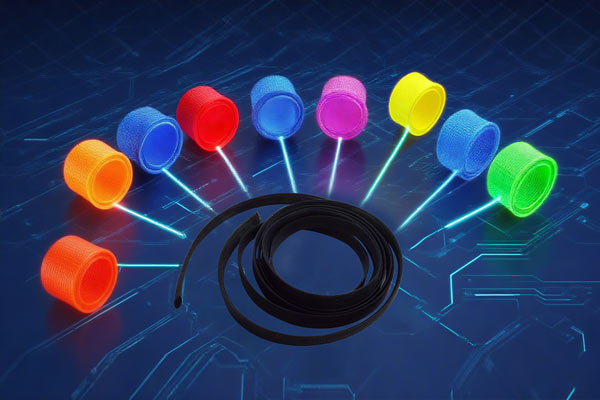
why black is not merely a preferred choice, but often an engineering imperative.
1. The Role of Carbon Black in Polymer Stabilization
Most black cable sleeves are manufactured from PET (Polyethylene Terephthalate) or PP (Polypropylene), both of which can degrade when exposed to UV radiation. The addition of carbon black, a finely divided form of elemental carbon, serves a dual function:
-
UV Absorption & Shielding: Carbon black particles absorb ultraviolet light and convert it into heat, protecting the polymer chains from photodegradation.
-
Free Radical Scavenging: It also disrupts the formation of free radicals, thereby slowing down the oxidative aging process of polymers.
2. Surface Energy and Contamination Resistance
From a physicochemical standpoint, black surfaces—especially matte-finished PET—have lower visual contamination sensitivity:
-
Oil, grease, and dust accumulation is less noticeable on dark-colored materials.
-
This is essential in environments such as engine bays, industrial control panels, and construction sites, where visual cleanliness contributes to perceived product reliability and maintenance efficiency.
3. Thermal Stability and Light Absorption
Contrary to the belief that black components absorb too much heat, well-formulated black sleeving performs exceptionally in thermal environments:
-
PET with carbon black can withstand continuous operating temperatures of +125°C, and even short-term spikes up to +150°C, without deformation or embrittlement.
-
In under-hood automotive environments, black sleeving offers thermal consistency and less UV-induced softening compared to colored counterparts, which are more prone to fading and cracking unless special stabilizers are used.
4. Cost Efficiency and Supply Chain Integration
From a manufacturing economics perspective, black sleeving offers several production advantages:
-
Stable dyeing process: Black pigmentation is easier to control and reproduce consistently, reducing quality variation.
-
Lower pigment cost: Carbon black is significantly cheaper than specialty colorants (e.g., UV-stabilized red or yellow).
-
Fewer line changeovers: Producing mostly black eliminates frequent machine cleaning and downtime, improving operational efficiency.
-
Simplified inventory: OEMs benefit from reduced SKU complexity, leading to more streamlined logistics and warehousing.
5. Color Coding vs. Lifecycle Management
Colored sleeving does have its place—especially in voltage identification, network cabling, and safety signaling. However, these applications are:
-
Low volume, often custom-ordered in small batches.
-
Prone to UV fading and dirt contamination, unless enhanced with expensive stabilizers.
-
Associated with higher quality control costs, as slight color variation can lead to functional misidentification in mission-critical systems.
Thus, most OEMs reserve colored sleeving for internal wiring, indoor systems, or areas requiring visual hierarchy, while relying on black for the main harness protection and outdoor exposure.
Black Is Not Just a Color, It's an Optimized System
From material chemistry to logistical simplicity and field performance, black cable sleeving is a strategically engineered choice. Its dominance reflects deep understanding of polymer behavior, UV degradation, contamination resistance, cost structures, and lifecycle performance.
For engineers and procurement professionals alike, selecting black sleeving isn't about defaulting to tradition—it's about embracing a solution that's been rigorously optimized through decades of industrial evolution.






 IPv6 network supported
  English